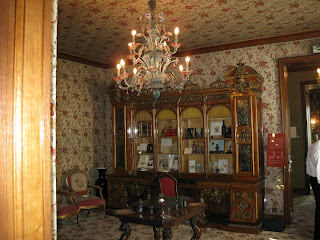
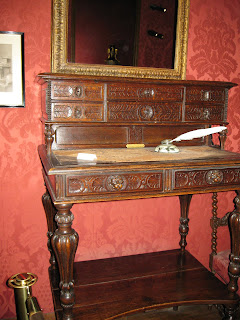
Now that I am back in Florida with fairly reliable Internet connections, I have redone my podcast on Famous British Murderers using PhotoStory 3 so that I could embed it in my blog. This file is 4.41 minutes long, in wmv format, and 2.61 MB.
Monday, August 3, 2009
Tuesday, July 28, 2009
A Jumble of Joyful Jobs
While traveling around the streets of London, Oxford, and Paris, I saw some very interesting occupations being performed. Here is a small selection of some of the positions that are available to enterprising folks. From the Royal Guardsmen to an itinerant juggler who was just trying to earn five pounds (probably to get himself a pint), they presented an intriguing tapestry of various types of employment. Just in case nobody's hiring librarians when I graduate, it gives me something to think about.
This video is in wmv format and is 97 mb, according to the information on my computer. It took about ten minutes to load, even here in the States. It's length is 3:05 minutes.
Multimedia Design, London and Paris, 2009
Click here to view this photo book larger
Here are a few of the many, many photos I took on this trip. It was very difficult to make the selections. Click on "Click here to view this photo book larger," then "View photo book."
Trip Motto: "Mind the Gap."
Recurring Photo Theme: Lion Monuments - Parliament, Trafalgar Square, Oxford, the British Museum, Highgate Cemetery, the Louvre, and the Lion of Belfort (copy) in front of the Catacombs (and there were a few others that didn't make it into the photo book).
Photo Emphasis:
*Stonehenge - Focusing on small point in foreground
*Salisbury Cathedral - Photo of building from unusual angle
*Trafalgar Square - Motion from a stationary position; sepia photo
*Oxford - Unusual signs
*British Museum - Duplicating another photo
*Regent's Park - Macro setting for flowers
*Abbey Road - Unusual angle
*Hyde Park - Reflections, repeat patterns, Stop-action water
*St. Pancras Station - Vertical and horizontal studies of same image
*Eiffel tower - Night setting
*The Louvre - Unusual angle of statue, reflections
*Epernay - French countryside, motion shot and 1600 ISO setting
*Catacombs - contrasts
*Pere Lachaise - Black and white (with a splash of color)
Saturday, July 25, 2009
The Changing of the Guard at Buckingham Palace
This is a brief example of the pomp and circumstance that goes with the changing of the guard in front of the Queen's residence at Buckingham Palace. We viewed this procession with our Blue Badge guide Hugh. I'm experimenting with different video formats so that I can begin working on my movie assignment. This file began as an MVI/AVI, went to WMV, and is now an MP4. It is 3.55 mb.
Tuesday, July 21, 2009
How French Frog Came to Be in France
This is the story of how French Frog came to stow away in a suitcase and make the journey to England and France this summer. He is happy to be home now, but he did have a wonderful time taking in all the things to see in both countries and mingling with Shaun and Troy and all the other mascots. I don't know if this is significant, but I did find the phone book open to travel agents this morning...
This file is a Windows Media Audio/Video file, wmv, 8.18 mb. It is 4:59 minutes long.
Friday, July 17, 2009
Notre-Dame, a Deportation Memorial, and a Farewell Dinner, a Time to Remember
In the afternoon we visited Notre-Dame Cathedral, famous for its antiquity (begun in the 1100's), its stained glass windows, flying buttresses, and gargoyles (and even for its hunchback, among literary fans). It is truly a marvel of engineering and very beautiful and majestic.
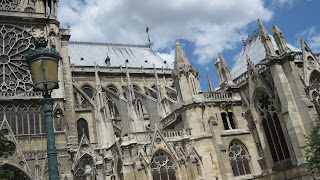
The famous flying buttresses of Notre-Dame
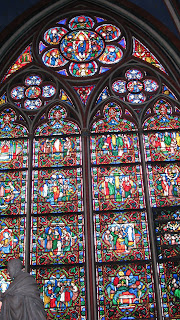
A beautiful stained glass window
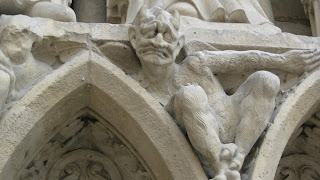
One of the many gargoyles who live at Notre-Dame
Behind the cathedral is a Memorial to the 200,000 Jewish Martyrs of the Deportation. During World War II, many Jews were rounded up by the Germans in France, as elsewhere, and transferred to concentration camps. The Vichy government tried to shield its French-born Jews as well as it could, and most of those transported from France had been born elsewhere. The village of Le Chambon Sur Lignon, in the mountains of southern France, is famous for its role in saving 5,000 Jews, many of them children, by hiding them and smuggling them to safety. The 3,000 people who lived there risked their lives daily to help their fellow countrymen because it was "the right thing to do." Yet many still died, and the Memorial includes a wall of 200,000 glass pearls, one for each person who was deported. The inscription states: "Forgive --but do not forget."
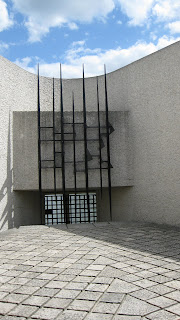
A part of the Memorial
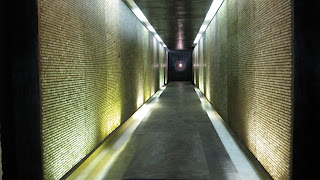
The wall of pearls, 200,000, one for each deportee
The afternoon saw us boating down the Seine for a tour of the historic sites from the water. Then we went to a delicious farewell dinner, where we were serenaded by two handsome gentlemen for the entire evening. It was a moment for looking back at the good times we have shared and for looking forward to new adventures abroad or going home. It has truly been a marvelous three weeks.
Tuesday, July 14, 2009
Cemetery Effects
A "street" in Pere Lachaise
A weeping figure mourns the one buried here
Monuments of every style and shape
All the way up the hill are monuments-A study in black and white
In the afternoon we saw the famous Sacre-Coeur Church (from a distance, as there was a huge crowd surrounding it), then spent several hours wandering through the surrounding neighborhood of Montmartre. Among other things, we bought some interesting artwork and saw the outside of the house at No. 54 rue Lepic where Vincent Van Gogh and his brother once shared an apartment. We walked to the Cimetiere de Montmartre, which is very similar to Pere Lachaise with its above ground vaults. Emile Zola is buried here. We also saw a number of feral cats about the place. Then back to the hotel for a Thai dinner and listening to fireworks in the distance.
Monday, July 13, 2009
A Day in the French Countryside with Wine
The wine celler looks a lot like the catacombs, only with higher ceilings and bottles instead of bones.
Today was a lovely, sunny day, and we had a great time with a tour of a French winery. We headed out of Paris by train and rode through the countryside, seeing quaint little villages along the way. Epernay is a beautiful town with a picturesque church and lots of shops and restaurants. We all had lunch at a pizzeria, and then we had an hour to explore the town before heading to the winery. I stumbled upon a small park with very colorful flowers and a town square with a fountain. Then we met at the winery for the tour. We were given a history of the Moet-Chandon family. It turns out Dom Perignon was a real person who discovered how to make wine effervesce, thus discovering the secret of champagne. We learned how the wine is actually a mixture of three different kinds of grapes and how they add yeast and sugar. The way the sediment is removed is quite fascinating. The bottles are turned upside down and rotated slowly every day for six weeks by hand (okay, some are done by machine, but some are still done the traditional way). Then the top of the bottle containing the sediment is frozen. When the cap is taken off the bottle, the pressure inside built up from the fermentation pops out the frozen sediment. Then more wine is added to fill the bottle, and it is aged some more. The tour culminated in a wine tasting event with both white and rose and ended up in the gift shop! This trip is easily one of the highlights of our stay in France. Tomorrow is Bastille Day, and tonight there is a free concert on the square down the road. We walked down the street to check it out.
French Frog waits patiently for his tour of the Moet-Chandon Winery.
He says it was well worth the wait.
The little park nearby held beautiful flowers
Sunday, July 12, 2009
Versailles
Saturday, July 11, 2009
Back in the Depths of the Earth
In the depths of the catacombs
Carving in the rock
Today's inside visit was to the catacombs beneath the streets of Paris. I had missed seeing the ones in Vienna because they were only open in the afternoon and on our one day there we had an afternoon tour of a palace. So I was looking forward to getting to see the ones here. If I thought I was a little morbid for wanting to go there, I was reassured when I got there and the line to get in was three quarters of the way around the block -- and most of the people in line seemed perfectly normal, like the neighbors who always say "hi" and wave when they see you. The museum does cap the number of visitors inside the catacombs at one time at two hundred, so it wasn't quite the same as the line to get into the Eiffel Tower, but we waited for about an hour and a half to get in. It was worth the wait. The only drawback was that they asked that no flash photography be done, so what pictures I took were basically black and blacker, as the lighting was not the best. One of the reasons I wanted to see this place is because I have read a series of mysteries set in Paris/France during World War II (by J. Robert Janes). One of the books climaxes with the French detective clashing with the murderer in the depths of the catacombs with the lights out. The French Resistance had their headquarters here, and it would be easy to "get lost" among the many tunnels before they were blocked off to keep the tourists from roaming. There are over a hundred steps down to the burial level, and about ninety going out at the exit. Near the entrance are several sculptures carved out of the stone, reminescent of the ones in the Polish salt mines near Krakow. As you move deeper into the underground passages, you come to the stacks of bones that were placed here when they were moved from the Cemetery of the Innocents during the 18th Century. It was thought that moving the bodies out of the cemetery and into the catacombs would halt the spread of disease. Under Napoleon, the bones were arranged into patterns with rows of skulls alternating with rows of other bones. Some of the other bones that were brought in after the French Revolution belonged to such famous people as Robespierre and possibly even Marie Antoinette and Louis XVI. Towards the end of the tunnel are several places where one can look up and see great caverns in the roof where there had been a collapse. Today the roof is repaired with injections of concrete whenever it gets shaky. Otherwise the cars traveling above might suddenly find themselves in a huge sinkhole. While this type of museum might not be for everyone (their website warns that it is not for those suffering with "nervous disease"), it was a very interesting way to spend the morning.
Today was our day for contrast photos. This sign for free Wi-Fi in the park was in direct contrast to all the trouble we were having at the hotel uploading photos and staying on the Internet. This is an example of irony!